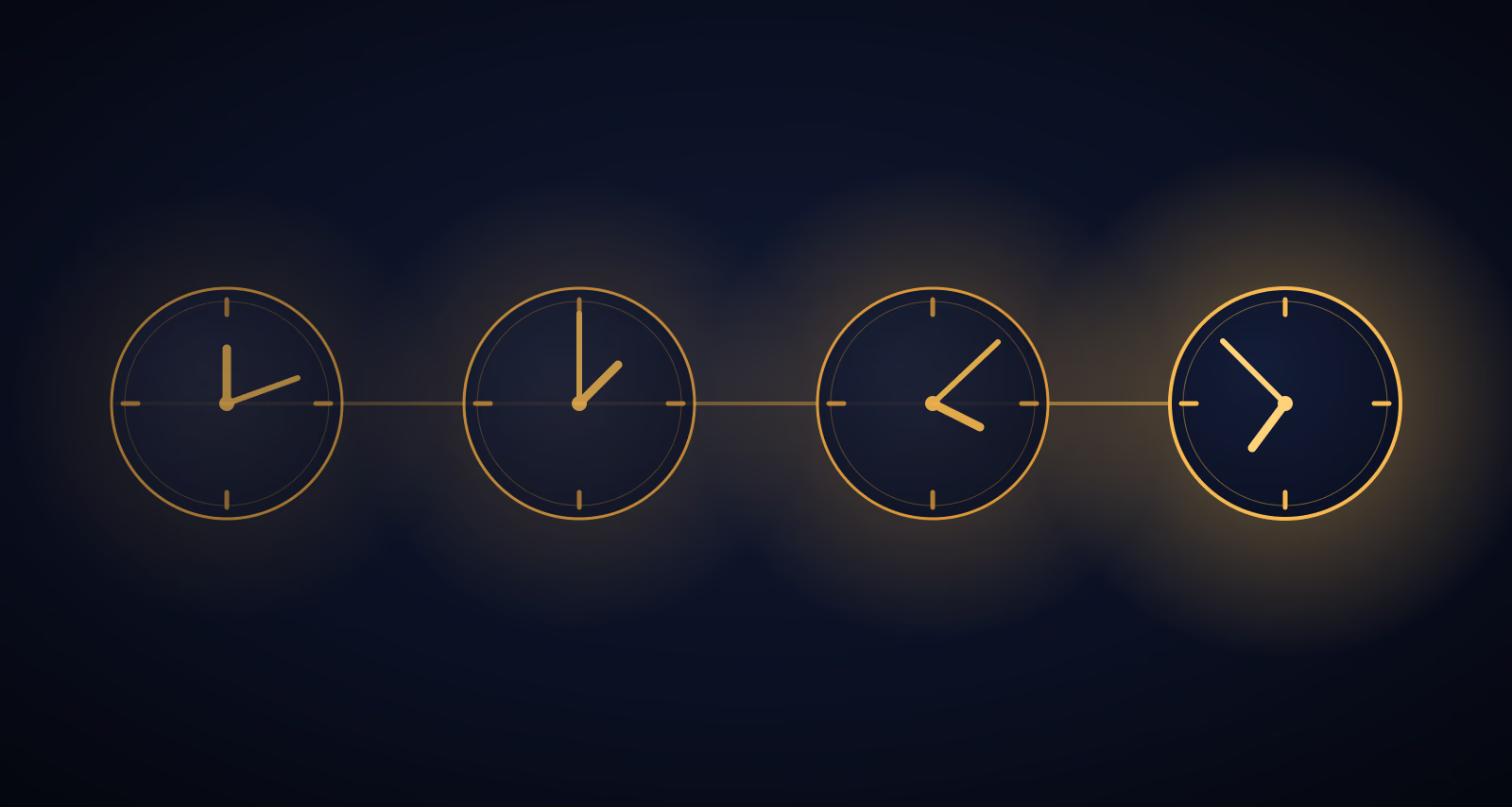
When somebody says SEO takes three months, six months or a year, they are usually compressing four different events into one answer.
A page can be indexed without earning an impression. It can earn impressions without clicks. It can earn clicks without producing a customer. Each is a separate clock, and each starts under different conditions.
For a brand-new site, the useful question is not “How long does SEO take?” It is: which clock are you actually waiting on?
SEO has four clocks, not one
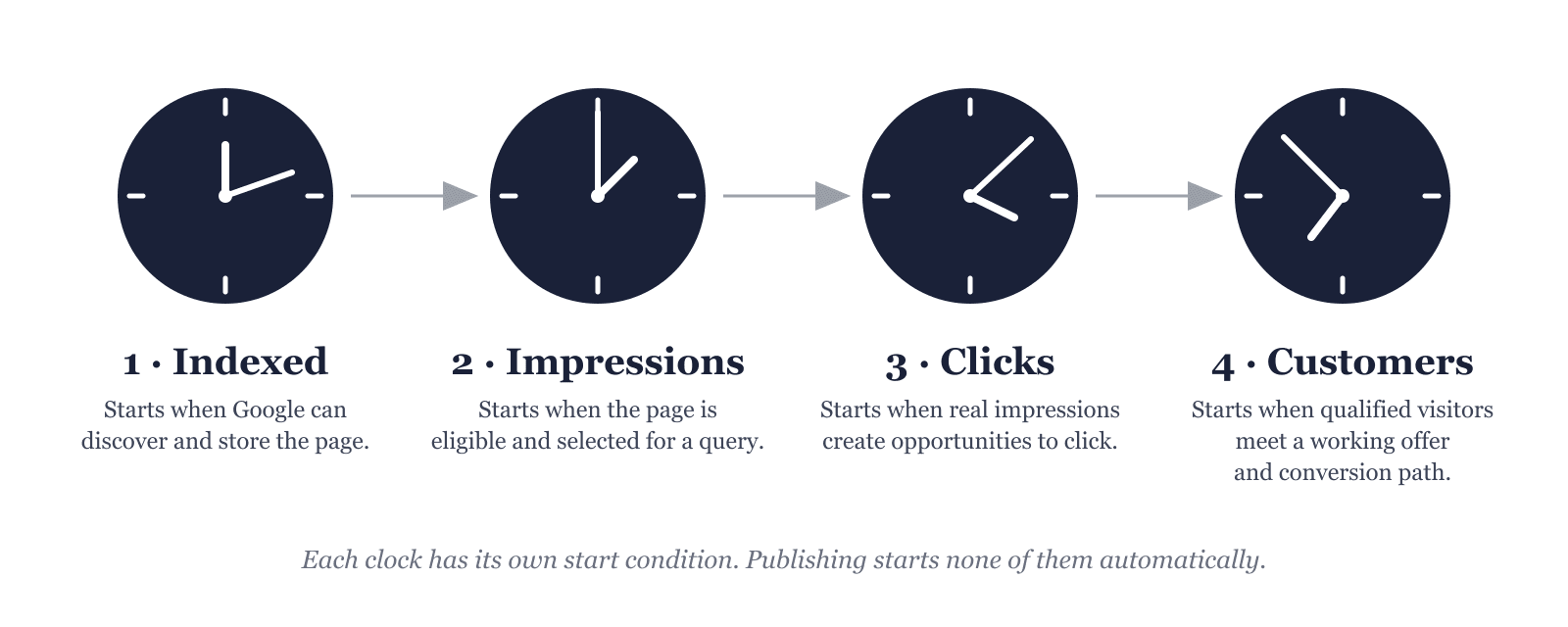
The four clocks are:
- Indexed: Google has discovered and stored the page.
- Impressions: Google has chosen the page for at least one search result.
- Clicks: A searcher has chosen your result.
- Customers: A visitor has taken the commercial action the page exists to support.
They are related, but they are not a single conveyor belt. An indexed page is not owed impressions. An impression is not owed a click. A click is not owed a customer.
That is why two founders can publish on the same day, do equally competent work, and report completely different timelines without either one lying.
Clock one: getting indexed can take days to weeks
Google says crawling can take from a few days to a few weeks after you request it. It also says that requesting a crawl does not guarantee immediate inclusion—or inclusion at all (Google Search Central). BORROWED: this is Google’s documented range, not a measurement from Unifounder.
The clock does not start because you bought a domain or pressed Publish. It starts when the page is discoverable: linked, included in a sitemap, allowed by robots rules, and actually visible in the server response.
If the page is absent from the index, check the machinery before rewriting the copy:
- Is the URL present in your sitemap?
- Does it return a successful response?
- Can a crawler read the headline and body without relying on your browser to assemble them?
- Does Search Console’s URL Inspection report show a block, canonical conflict or discovery problem?
We learned this distinction the expensive way. Our own blog deployed successfully twice while containing zero posts: once because its markdown never reached the deployed function, and once because a deployment rule stripped every markdown file before the build. PROVEN in our repository history.
A green deployment was not evidence that the content existed. The sixty-second crawler check is here.
Clock two: impressions begin only when Google chooses you for a query
Indexing is a filing decision. An impression is a competitive one.
Once a page is indexed, there is no official countdown that guarantees impressions. Google still has to understand the page, connect it to a query somebody actually uses, and prefer it over other eligible answers.
This is where generic timelines become dangerous. “It has been indexed for two weeks” is not evidence that the page should already appear. The page may be new. The phrasing may have no demand. The query may be dominated by sources with much stronger authority. Or the page may answer a question adjacent to the one people type.
For this clock, watch states and counts rather than daily traffic:
- the number of distinct queries your site appears for;
- indexed pages versus submitted pages;
- whether crawl frequency is increasing;
- whether your actual text is present in a crawler-visible response.
Those are readable before traffic ratios are. We explain why in the low-traffic measurement guide.
If a page is indexed but has no impressions, use the four-check decision tree before deciding that the page is broken.
Clock three: clicks do not run on calendar time
The click clock starts only when you have enough real impressions to create opportunities for a click.
A page can sit at position 60 for several queries and technically accumulate impressions while producing no visits. That is not the same condition as an indexed page with no impressions. The first has entered the competition; the second has not yet been selected.
Clicks depend on three things you should keep separate:
- Query fit: does the page answer what the searcher meant?
- Position: is the result high enough to be noticed?
- Choice: does the title and description give the searcher a reason to choose it?
None of those improves merely because another week passes.
Do not read click-through rate too early. At low volume, one click can transform the percentage and create the illusion that something fundamental changed. Use the underlying counts first: queries, impressions, positions and clicks. Read the rate only when its denominator is large enough to stop jumping whenever one person behaves differently.
Clock four: customers are not an SEO metric
A search click delivers a visitor. It does not validate the offer.
The customer clock requires a qualified query, a relevant page, a credible proposition, and a conversion path that actually works. If any one is missing, more traffic can produce more evidence of the gap without producing revenue.
This clock can also start before the other three. A founder can send the page directly to five relevant people and win a customer while Google is still deciding whether to index it. That customer is real, but it is not evidence that SEO is working. It is evidence that direct distribution reached somebody with the problem.
The reverse is possible too: search traffic can grow while customers remain at zero. That is not automatically an SEO failure. It may be a mismatch between the queries you attract and the action you want, or a weak offer, or a broken form.
Before interpreting a flat conversion line, verify that the system records anything at all. Our ten-minute tracking check starts there.
What is normal for a new site?
A useful timeline is conditional, not universal:
| Clock | It starts when | What “normal” means early | Investigate when |
|---|---|---|---|
| Indexed | The page is discoverable and crawlable | Crawling may take a few days to a few weeks; inclusion is not guaranteed | The page remains undiscovered, blocked, wrongly canonicalised or unreadable to crawlers |
| Impressions | The indexed page becomes eligible and selected for a query | Query coverage may begin at zero and grow before clicks appear | The page has no plausible query fit, or all technical checks pass and selection never begins |
| Clicks | Real impressions exist | Counts may remain tiny and click-through rate unstable | Impressions grow but the page stays unseen, irrelevant or unchosen |
| Customers | Qualified visitors meet a working offer and path | Direct conversations may beat search to the first customer | Relevant visits arrive but the proposition or conversion path repeatedly fails |
The point of this table is not to replace one false promise with four smaller promises. It is to show which mechanism deserves your attention.
Diagnose the clock before changing the work
If your page is not indexed, fix discovery or rendering.
If it is indexed with no impressions, test query fit and competition.
If it has impressions with no clicks, inspect position and the reason to choose your result.
If it has relevant clicks with no customers, inspect the offer and conversion path.
Do not hire an SEO agency to repair a form. Do not redesign a landing page because Google has not crawled it. Do not rewrite a useful article because a two-week-old chart is flat.
Most wasted work begins by treating all four clocks as one.
Building alone and unsure which part of your company is actually working? Join the Unifounder waitlist.