
Most advice on whether your SEO is working assumes you have traffic to analyse. Below roughly a hundred sessions a month, the metrics it tells you to watch are noise — and reading them anyway will mislead you more reliably than measuring nothing at all.
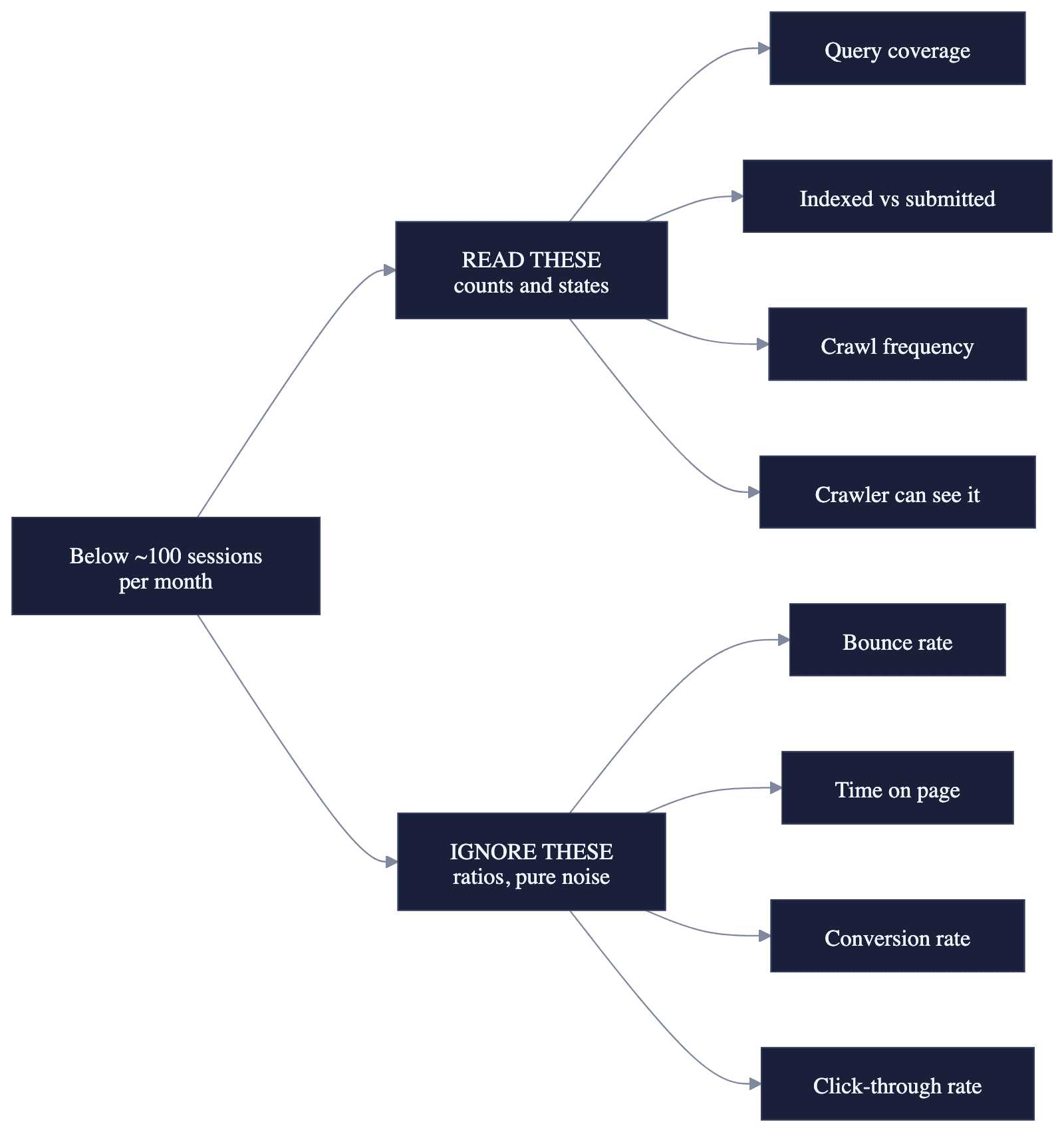
Four things are genuinely readable at low volume. Everything else is a coin flip you are interpreting as a signal.
The advice that ranks first is wrong for you
The page currently ranking at the top for "how to know if your SEO is working" says this:
"If your website isn't getting traffic, your SEO efforts aren't working."
For an established site, fair enough. For a site that is six weeks old, this is simply false, and acting on it means quitting or hiring in exactly the window where neither is warranted.
The reason is mechanical. Nearly every metric in the standard list is a ratio — bounce rate, conversion rate, click-through rate, average time on page. Ratios need a denominator to be meaningful. At forty sessions a month, one unusually curious visitor moves your average time on page by half a minute, and one bounce moves your bounce rate by two and a half points. You are not measuring your site. You are measuring who happened to show up.
A more careful source in the same results is closer: impressions typically appear two to six weeks after a page is indexed, and clicks lag impressions by weeks again (MasterSEOTool, June 2026) BORROWED — that is their field observation, not our measurement. The two pages give opposite verdicts on the same month-two dashboard. The second one is right, and the first one ranks higher.
The four things that are readable at low volume
These work because they are counts and states, not ratios. One visitor cannot swing them.
1. Query coverage — the count of distinct queries you appear for
In Search Console's Performance output, remove every filter, set the range to the last 28 days, and open the Queries tab. Ignore the positions and the clicks. Count the rows.
Three distinct queries at position 70 is meaningfully better than zero queries, and it moves months before any click does. It is the earliest honest evidence that search engines have understood what your pages are about — which is the thing you are actually trying to establish at this stage.
Watch the count go 0 → 3 → 11 → 40. That trajectory is real information at any volume.
2. Indexed pages against submitted pages
Search Console → Pages. Two numbers: how many you have submitted, how many are indexed.
The gap closing over weeks is progress. The gap frozen for a month is a signal worth investigating. This is a count of states, so it is trustworthy from your very first page.
3. Crawl frequency
Search Console → Settings → Crawl stats. You are asking one question: is Google coming back, and more often than before?
A site being crawled weekly and then twice a week is being taken more seriously. A site crawled once and never revisited has a problem that no amount of new content will fix.
4. Whether crawlers can see your content at all
Not a metric — a binary state, and the one that invalidates everything else if it fails. One command answers it, and on sites built with AI tools it fails more often than anyone expects.
What to ignore until you cross about a hundred sessions a month
| Metric | Why it's unreadable at low volume |
|---|---|
| Bounce rate | One visitor swings it by several points |
| Average time on page | One outlier moves the mean by minutes |
| Conversion rate | Needs dozens of conversions before the rate means anything |
| Click-through rate | Needs hundreds of impressions per query before it's stable |
| Traffic sources / channel mix | Small numbers plus imperfect attribution equals fiction |
None of these are bad metrics. They are fine metrics being asked a question they cannot answer yet. Set them aside deliberately rather than staring at them, and revisit when the denominator can support them.
The honest position nobody sells
Here is the thing that no tool vendor will tell you, because there is nothing to sell attached to it:
For the first month or two, you genuinely cannot tell whether your content is good. The signal does not exist yet. Anyone offering you a way to know is selling something.
What you can tell is whether the machinery works: are pages indexed, is the crawler returning, is query coverage rising from zero, can crawlers read the page. Those four answer "is this thing plugged in?" — and that is the only question available in month one.
We hold this position from experience rather than theory. Our own blog shipped empty twice in a single day in August 2026 — once because the content never reached the deployed function, once because a deployment rule stripped every markdown file before the build. PROVEN, both in our public commit history. Every dashboard we owned was green throughout. The machinery question is not a lesser question; it is the one that catches the failures that actually happen.
What to do with the waiting
Two things are worth more than refreshing a dashboard:
Publish the next piece. Query coverage grows with surface area, and surface area is the only input you fully control.
Talk to people directly. At this stage, five conversations tell you more about whether your content answers a real question than a month of analytics can. The founders who get through this window are the ones who stop treating a flatline as a verdict and go and find out whether anyone recognises the problem they are writing about.
If your pages are indexed and still showing nothing at all, that has its own decision tree — and a specific point at which normal waiting stops being normal.
Building alone and unsure whether any of this is working? That uncertainty is the problem Unifounder exists to remove.