
If you are about to hire an SEO agency, the single most useful thing you can do is agree five numbers before you sign — and make sure you can read all five yourself, in accounts you own.
This is not an argument against hiring one. Good agencies exist and do work most founders cannot. It is an argument against the position almost everyone ends up in: paying every month, receiving a output, and having no way to tell whether the output describes progress.
The complaint is not about money
The largest thread we found on this — 358 comments — is titled "Over $10,000 a Month for SEO??" (r/SEO, August 2026). Read it and the anger is not really about the ten thousand. It is about not being able to tell what the ten thousand bought.
The same shape appears at every price point:
"I've hired 3 different SEO people over the years and none of them have been able to improve my website ranking much. … I'm not sure if the problem is my website, SEO, ads, or just the competition." — r/SEO, August 2026
That last sentence is the actual problem. After three engagements and years of spending, the honest summary is I cannot attribute the outcome to anything. An agency that delivers real work and an agency that delivers very little produce identical experiences from the client's chair, unless you set up the means to tell them apart in advance.
The five numbers
Agree these before signing, in writing, and confirm you can read each one yourself.
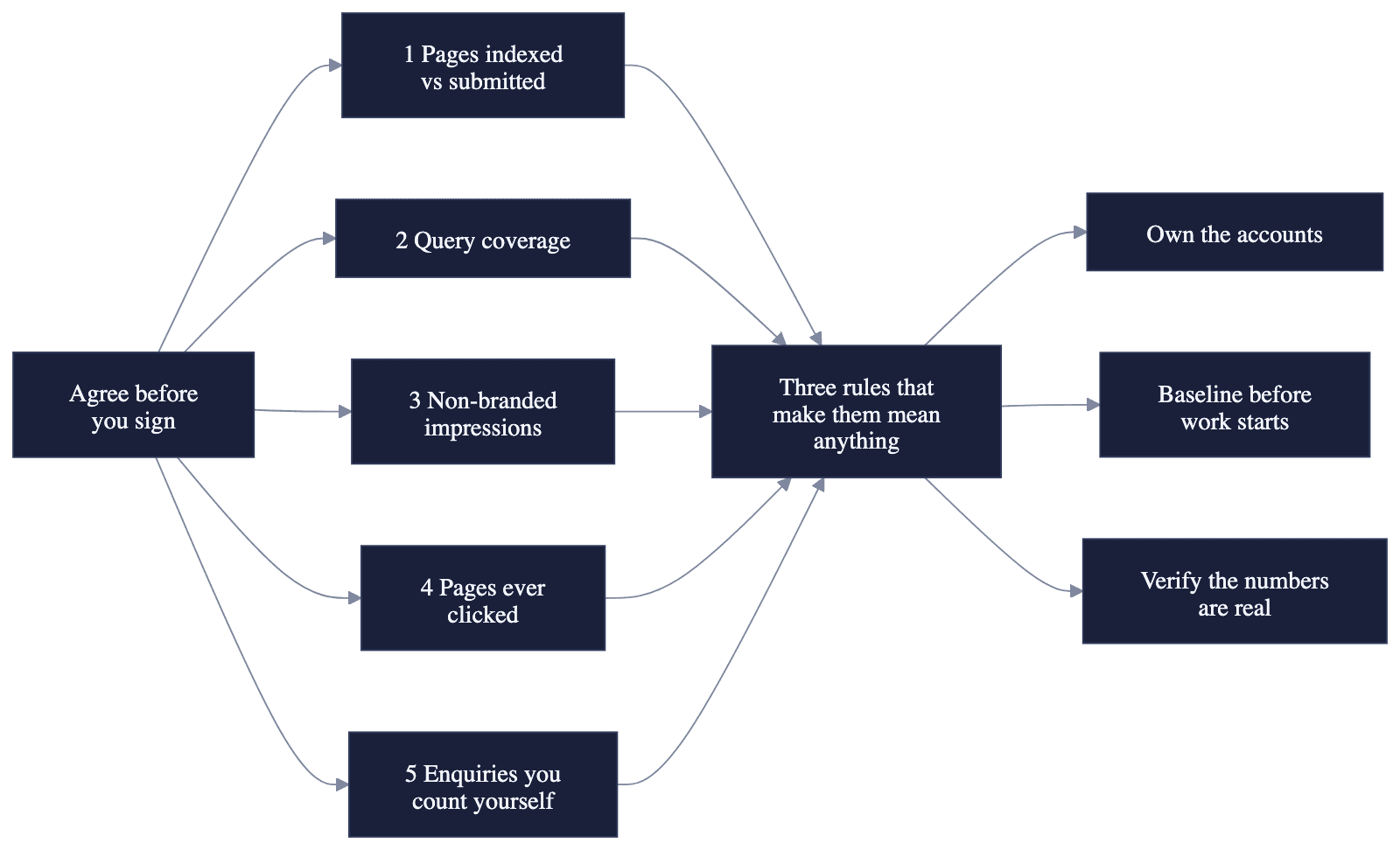
1. Pages indexed, against pages submitted
Where: Search Console → Pages. Why: it is the most basic evidence that work is reaching search engines at all. New pages appearing and getting indexed is a floor, not a triumph — but a flat line here after three months means something is badly wrong, and it is visible from month one.
2. Query coverage — the count of distinct queries you appear for
Where: Search Console → Performance → Queries, no filters. Count the rows.
This is the number to watch most closely in the first six months, and almost nobody puts it in a contract. It rises long before rankings or clicks do, it cannot be gamed by reporting on branded terms, and it answers the real question: are search engines understanding more of what we do over time?
3. Impressions on non-branded queries
Where: Performance output, filtered to exclude your company name.
The filter matters enormously. Branded impressions rise when your other marketing works, and including them lets an agency's output ride on effort they had nothing to do with. Non-branded impressions are the honest measure of whether anyone new is finding you.
4. The number of pages that have ever received a click
Where: Performance → Pages, sorted by clicks.
A site with a hundred pages where four have ever been clicked has a very different problem from one where sixty have. This number tells you whether the work is producing broadly useful pages or a handful of accidental winners — and it is the one most likely to embarrass a large content programme.
5. What actually happens after someone arrives
Where: whatever holds your enquiries — your CRM, your inbox, your form's destination.
This is the number most contracts never mention, and the only one connected to revenue. Agree what an outcome is: an enquiry, a booking, a signup. Agree that you will count them yourself, in a system you control. An agency that pushes back on this is telling you something.
The three rules that make the numbers mean anything
Own the accounts. Search Console and analytics should be in accounts you own, where you add the agency as a user. Never the reverse. This costs nothing to arrange at the start and is extremely difficult to unwind later, and it is the difference between having a measurement system and renting one.
Take a baseline before any work starts. Write down all five numbers on the day you sign, and keep a copy outside their reporting. Month one is the only time you can ever capture it, and without it every later comparison is somebody's recollection. As one practitioner put it after losing this: without a pre-change baseline "you can't tell if the new title actually worked."
Verify the numbers are real before you trust them. A number can be wrong in ways that produce no error message. We audited our own site in August 2026 and found no analytics installed in production at all, and — after fixing that — a middleware rule that was silently redirecting every tracked event to a login page. Clean console, empty dashboard, no warnings. PROVEN; both are in our public commit history. The ten-minute check that catches this is worth running before your baseline, not after.
The two questions worth asking in the call
Ask these, and listen for how specific the answer is.
"What will change in the first ninety days, and which of these five numbers will show it?" A good answer is narrow and unimpressive — technical fixes, a handful of pages, indexing improvements. An answer that promises rankings in ninety days is either inexperienced or telling you what you want to hear. Google's own long-standing guidance is four months to a year before meaningful results, and that figure has been repeated for years.
"If we do all this and the five numbers barely move, what would that tell us?" The answer you want acknowledges that it is possible. Anyone whose plan cannot fail is not running a plan.
If you decide to do it yourself
The five numbers do not change. You still need the baseline, you still need to verify your tracking is real, and you still need to resist reading ratios at low volume — most of them are noise below about a hundred sessions a month, whoever is doing the work.
The difference is only who does the writing. The measurement discipline is identical, and it is the part that determines whether you learn anything either way.
Building alone and unsure whether the money you're spending on marketing is doing anything? That uncertainty is the problem Unifounder exists to remove.